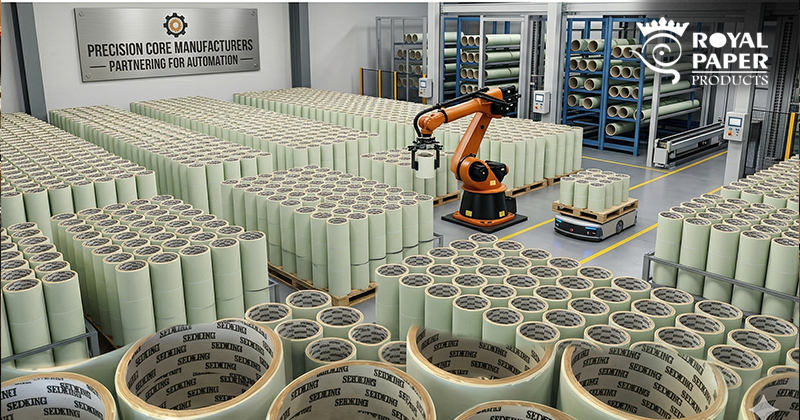
In the high-stakes world of modern manufacturing, “downtime” is a four-letter word. Whether you are bottling artisanal kombucha or shipping thousands of consumer electronics daily, the goal is always the same: fluidity. When we talk about packaging automation, we usually marvel at the high-speed robotic arms, the intricate conveyor systems, and the laser-guided sensors. But as a manufacturer, I can tell you that even the most expensive automated line is only as reliable as its smallest component.
At the very heart of these high-speed systems lies a humble, often overlooked cylinder: the labeling core. It’s easy to dismiss a cardboard or plastic tube as a “commodity,” but in the realm of automation, Labeling Cores Manufacturers are the unsung architects of efficiency.
Here is how the right core makes the difference between a seamless shift and a mechanical nightmare.
1. Precision Engineering for High-Speed Application
Automation thrives on consistency. In an automated labeling environment, a roll of labels is fed through a series of tensioners and rollers at incredible speeds. If the core is even a fraction of a millimetre out of round, it creates a “wobble.”
This eccentricity leads to:
- Web breaks: The uneven tension snaps the label backing.
- Misalignment: Labels are applied crookedly, ruining the aesthetic of your product.
- Sensor errors: The machine misreads the gap between labels because the roll isn’t spinning smoothly.
Expert Labeling Cores Manufacturers use precision cutting and winding techniques to ensure that every core is perfectly cylindrical and dimensionally stable. When the core is true, the tension remains constant, and the machine can run at its maximum rated RPM without a hitch.
2. Strength Under Pressure: Crush Resistance
In an automated warehouse, rolls are often stacked high. Furthermore, the labeling machines themselves apply significant “rewind tension.” If a core is cheaply made, it can “ovalize” or collapse under the weight of the labels or the pressure of the machine’s mandrel.
If a core collapses while on the machine, the entire line grinds to a halt. You can’t just “pop” it back into shape. You’re looking at manual intervention, wasted materials, and lost minutes that add up to thousands of dollars. We manufacture our cores to withstand specific radial crush strengths, ensuring they stay rigid from the moment they leave the factory until the last label is peeled off the roll.
3. Specialized Finishes and Surface Friction
The idea that all core surfaces are the same is wide-spread. The “start” of a label roll is actually a crucial point for automation.
The “Grab”: The labels may slip during the first high-speed wind if a core is excessively slick, resulting in “telescoping” (where the roll sags or pushes out to one side).
The “Release”: On the other hand, specific applications call for the core to remove the final label in a clean manner without leaving behind any adhesive residue that can clog the machine’s internal parts. Working with specialized Labeling Cores Manufacturers allows you access to special finishes, such “parchment” liners or embossed surfaces, that provide the perfect amount of friction for your specific adhesive and machine type.
4. Smart Factory System Integration (Industry 4.0)
As we enter the era of the “Smart Factory,” the core is changing along with it. RFID or barcode tracking are frequently used in modern packaging automation to track batch data and inventory.
These days, sophisticated manufacturers are incorporating tracking technology right into the cores. As a result, the automated system can:
- Make sure the right label roll is being used for the particular product on the line by verifying the batch.
- Monitor Usage: Keep track of the precise number of linear feet of labels left, and send the procurement team an automated “low stock” warning.
- Maintain a digital thread from the primary manufacturer to the final customer to guarantee traceability.
5. Sustainability: The New Efficiency Measure
Automation is about cutting waste, not simply speed. Conventional plastic cores are robust, but they provide a serious disposal issue. As a forward-thinking manufacturer, we have witnessed a significant trend toward recyclable, high-strength fiber cores.
Contemporary fiber cores are designed to be 100% recyclable or biodegradable while maintaining the strength of plastic. You may achieve corporate ESG (Environmental, Social, and Governance) objectives and make sure your automated line is “green” from the inside out without compromising a single PSI of crush strength by working with the correct manufacturer.
Why Your Choice of Manufacturer Matters?
You wouldn’t put budget tires on a Formula 1 car. Similarly, you shouldn’t put a “budget” core into a million-dollar packaging line.
When you vet Labeling Cores Manufacturers, you aren’t just looking for a vendor; you are looking for a partner in uptime. You need someone who understands:
- Tolerances: The difference between “close enough” and “perfect.”
- Material Science: Which paper grades or polymers handle humidity and temperature shifts best.
- Customization: Providing the exact IDs (Inside Diameters) and wall thicknesses your specific machinery requires.
Conclusion,
A high-speed production line is ultimately a technical marvel, but it is only as strong as its weakest link. As manufacturers ourselves, we at Royal Paper Cone know that you don’t just need a supplier; you need a partner who understands that a three-cent deviation in a core diameter can lead to a thirty-thousand-dollar headache in downtime.
We don’t just “make tubes.” We engineer the foundation upon which your automation thrives. By prioritizing precision, crush resistance, and sustainable materials, we ensure that when your machines ramp up to full speed, the only thing you have to worry about is keeping up with the demand for your product.