In the world of high-speed manufacturing and industrial logistics, it is often the smallest components that carry the heaviest burden. We talk a lot about massive turbines, AI-driven assembly lines, and heavy-duty steel frames. But if you look closer—at the spinning rotors of a textile mill, the delicate feed lines of a chemical plant, or the organized chaos of a construction site—you’ll find the unsung hero: Plastic Cones.
When you are operating at scale, “good enough” usually isn’t. You need components that can withstand thermal stress, chemical exposure, and the relentless vibration of 24/7 production cycles. That is why finding a Reliable Plastic Cone Manufacturer isn’t just a procurement task; it’s a strategic move for your bottom line.
Why “Plastic” is No Longer a Simple Word
There was a time when “plastic” was synonymous with “disposable.” Those days are long gone. Today’s industrial-grade polymers are engineered marvels. When we discuss high-performance industrial needs, we are talking about materials like Polypropylene (PP), High-Density Polyethylene (HDPE), and specialized Nylons.
A top-tier manufacturer doesn’t just mold shapes; they engineer solutions. Here is what separates a standard supplier from a high-performance partner:
1. Material Integrity and Durability
Industrial environments are brutal. Whether it’s the high-tension winding in a yarn factory or the UV exposure on a highway, Plastic Cones must maintain their structural integrity. A reliable manufacturer uses virgin resins rather than low-grade recycles that crack under pressure.
2. Precision Engineering and Tolerances
In automation, a mill
meter is a mile. If a cone is slightly out of round or has an inconsistent wall thickness, it can cause machine downtime, yarn breakage, or sensor errors. High-performance needs require injection molding processes that guarantee tight tolerances every single time.
3. Customization for Niche Applications
Every industry has its “quirks.” You might need:
- Anti-static properties for electronics environments.
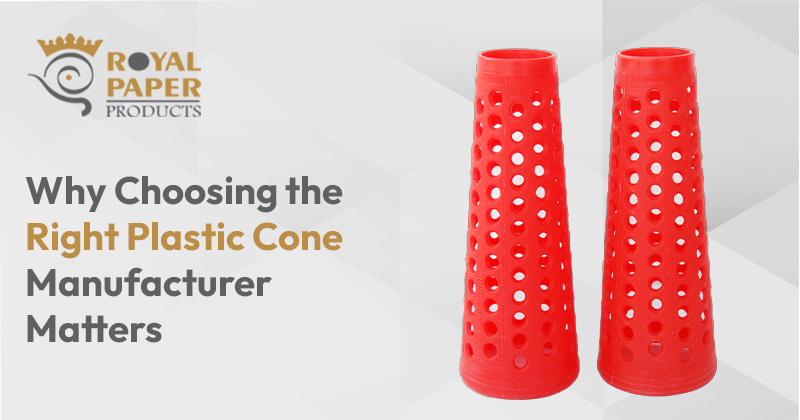
- Perforated surfaces for steam-setting in textiles.
- High-visibility pigments for safety and traffic management.
- Micro-grooved textures for specific grip requirements.
The Core Industries Relying on High-Performance Plastic Cones
You might be surprised at just how ubiquitous these tapered tools are. Let’s look at where quality truly makes a difference.
The Textile and Yarn Industry
This is perhaps the most demanding sector for plastic cones. In textile manufacturing, cones serve as the “carrier” for miles of thread. If the surface of the cone isn’t perfectly smooth, the yarn snags. If it’s too smooth, the yarn sloughs off. A professional manufacturer understands the science of surface finish, ensuring the perfect balance between grip and release.
Traffic Safety and Infrastructure
When we think of Plastic Cones, we often picture the bright orange markers on the road. But industrial-grade safety cones are a different breed. They need to be heavy enough to resist wind, flexible enough to survive being run over, and chemically treated to resist fading under the harsh 2026 sun.
Laboratory and Chemical Processing
In lab settings, cones are often used for centrifugation or as funnels. Here, chemical resistance is king. A manufacturer focused on high-performance will ensure their products don’t leach chemicals into the samples or degrade when exposed to acidic environments.
What to Look for in a Reliable Manufacturer
If you are sourcing for a large-scale operation, you can’t afford to play “vendor roulette.” Here is a checklist to evaluate your potential partner:
|
Feature |
Why It Matters |
|
In-House Tooling |
Allows for faster prototyping and better-quality control over the molds. |
|
Quality – Certification |
ISO 9001 compliance ensures consistent processes and fewer defects. |
|
Scalability |
Can they handle an order of 500 units as easily as 50,000? |
|
Sustainability |
Do they offer closed-loop recycling programs for old or broken cones? |
The Hidden Cost of “Cheap” Cones
It’s tempting to go with the lowest bidder. However, in an industrial context, the “unit price” is only a fraction of the total cost.
Imagine a scenario where a batch of low-quality Plastic Cones is integrated into your spinning frames. Halfway through the shift, the base of a cone shears off due to centrifugal force. The machine jams, the technician has to be called, and you lose three hours of production.
The $0.10 you saved per cone just cost you $5,000 in downtime.
Reliable manufacturers focus on Total Cost of Ownership (TCO). By investing in higher-grade polymers and better molding techniques, they provide a product that lasts longer, performs better, and keeps your machines running at peak efficiency.
Innovation in Plastic Cone Design
The industry isn’t standing still. We are seeing a massive shift toward smart manufacturing. Some high-end plastic cones are now being designed with:
- RFID Integration: Tracking inventory and batches becomes seamless when the carrier itself has a digital identity.
- Eco-Polymer Blends: Moving toward bio-based plastics that offer the same strength as traditional petroleum-based products but with a lower carbon footprint.
- Heat-Resistant Alloys: Polymers that can withstand temperatures exceeding 150°C without warping, perfect for specialized industrial steaming.
Conclusion:
At the end of the day, a Plastic Cone is only as reliable as the name stamped on its base. At Royal Paper Cone, we understand that our products aren’t just standalone items—they are the pulse of your production line, the safety of your crew, and the foundation of your logistics. We don’t just “sell plastic.” We provide the peace of mind that comes from knowing your components won’t fail when the pressure is on. By blending cutting-edge polymer science with a transparent, partner-first approach, we ensure that every cone leaving our facility is a testament to industrial excellence.
In a world where “good enough” is the norm, Royal Paper Product is dedicated to the exceptional. Because when your high-performance requirements intersect with our precision engineering, the outcome is more than just a product – it’s a competitive advantage.