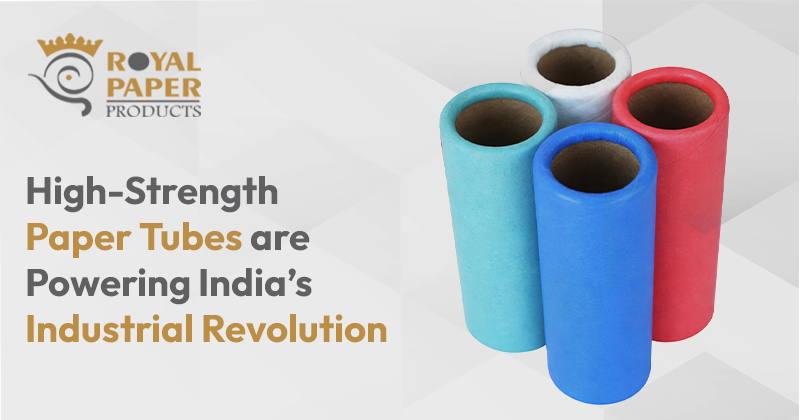
When you think of a paper tube, your mind might jump to the humble core of a toilet roll or the mailing tube that delivered your degree. But in the heartbeat of India’s industrial sectors—from the sprawling textile mills of Coimbatore to the massive steel plants in Jamshedpur—the paper tube is a silent, high-performance hero.
As India pushes toward becoming a global paper tubes manufacture hub, the demand for sustainable, durable, and precision engineered packaging has skyrocketed. Let’s pull back the curtain on how these cylindrical powerhouses are faring in the industrial landscape.
What exactly is an Industrial Paper Tube?
In the industrial world, we don’t just call them “cardboard rolls.” These are Spiral-Wound Paper Cores. They are engineered by winding layers of high-grade recycled paperboard with specialized adhesives under immense pressure.
The result? A structure with incredible crush resistance and dimensional stability. In a country like India, where environmental regulations are tightening and “Plastic-Free” is the mandate, paper tubes offer a biodegradable alternative that doesn’t compromise on strength.
Core Applications: Where India Uses Paper Tubes
1. The Textile Industry: The Backbone of Exports
India is one of the world’s largest textile producers. Whether its cotton yarn, synthetic fibers, or premium silk, these fabrics need to be wound onto something.
∙ POY (Partially Oriented Yarn) Tubes: These are high-speed tubes designed to withstand the immense centrifugal force of spinning machines.
∙ Fabric Bolts: Every time you see a roll of denim or upholstery in a market like Surat or Ahmedabad, it’s supported by a heavy-duty paper core that prevents the fabric from wrinkling or collapsing.
2. Flexible Packaging and Plastic Films
Think about the milk pouches, biscuit wrappers, and snack packets you see in every Kirana store. Before these are cut and sealed, they exist as massive rolls of plastic film.
∙ High-Surface Smoothness: Industrial paper tubes used here must be incredibly smooth. Any bump or seam on the tube would telegraph through the thin plastic, ruining kilometers of expensive film.
3. The Paper and Print Industry
It’s ironic, but the paper industry needs paper tubes to produce paper. Massive “Jumbo Rolls” of newsprint or craft paper—weighing several tons—are wound onto reinforced paper cores. These cores must be strong enough to be lifted by heavy machinery without buckling.
4. Steel and Aluminum Coils
You might be surprised to find paper in a steel mill. However, specialized, high-thickness paper tubes are used as cores for winding thin sheets of aluminum and stainless steel. They offer a “soft” grip versus metal mandrels, so the inside layer of the metal will not get scratched or deformed.
Why Indian Industries are Swapping Plastic for Paper
The shift isn’t just about being “eco-friendly” (though that’s a huge plus). It’s about the bottom line.
|
Feature |
Paper Tubes |
Plastic/ Metal Alternatives |
|
Cost Effectiveness |
Significantly lower production and shipping costs. |
High initial investment and energy intensive. |
|
Weight |
Lightweight, reducing “dead weight” in logistics. |
Heavy, increasing fuel consumption in transport. |
|
Customization |
Easily cut to any length or thickness. |
Often requires expensive molds or tooling. |
|
Disposable |
100% Recyclable and biodegradable. |
Leads to landfill waste or expensive smelting. |
The Engineering behind the Strength
How does “paper” hold up hundreds of kilograms? It comes down to two factors: Beam Strength and Crush Resistance.
Industrial manufacturers in India apply $Crush Strength$ tests to check that the tubes don’t get squeezed by the weight of the material wrapped around them. The formula for the load-bearing capacity often involves the thickness of the wall ($t$) and the inner diameter ($d$).
Challenges and Innovations in the Indian Market
Operating in India comes with unique challenges—specifically humidity. During the monsoon season, standard paper can absorb moisture and lose its structural integrity.
To combat this, Indian innovators have developed:
∙ Moisture-Resistant Coatings: Using wax or specialized polymers to “waterproof” the tube. ∙ Polished Finishes: Ensuring no friction when films are unwound at high speeds.
∙ Custom Branding: Printing logos and batch numbers directly on the inner or outer ply for better supply chain tracking.
The “Green” Advantage: Circular Economy in Action
In India, the Scrap dealer system has always been a primitive form of a circular economy. Industrial paper tubes fit perfectly into this. Most tubes are made from 100% recycled Kraft paper. When a yarn core has been completely used up by a factory in Punjab, the core is repulpable and it can be recycled into a shipping box or another tube.
This alignment with the “Make in India” and “Green India” initiatives makes paper tubes a favorite for companies looking to improve their ESG (Environmental, Social, and Governance) scores.
Choosing the Right Supplier: What to Look For?
If you are an industrial buyer in India, don’t just look at the price. Look at: Royal Paper Products
∙ Tolerance Levels: Does the tube fit your machine mandrel perfectly? A 1mm error can cause massive vibration at high speeds.
∙ Burnished Ends: Smooth edges prevent snagging of delicate fibers or films.
∙ Adhesive Quality: Ensure they use eco-friendly, high-bonding glues that don’t delaminate under heat. The Future: Smart Tubes?
Furthermore, embedding RFID technology and QR codes in the paper layers themselves will be the next major development of paper tubes in India. This allows warehouses to track “the roll” without needing external labels that might fall off. From a simple shipping tool to a data-carrying asset—the paper tube is evolving.
Conclusion,
As we’ve explored, the industrial paper tube is far more than just a hollow cylinder; it is the structural heartbeat of India’s manufacturing prowess. From the rapid spinning textile spindles to the large metal coils of our industrial belts, these tubes demonstrate that environmental responsibility and durability are not only compatible but go hand in hand.
At Royal Paper Product a leading paper tube manufacturer, we don’t just see ourselves as suppliers; we see ourselves as your partners in precision. Basically, it is almost impossible to be aware that in a very tough factory environment situation, a difference in thickness of merely one hundredth of a millimeter or a diminishment of the paper boards crush resistance by a tiny bit can be the reason of a production line running smoothly or a very expensive shutdown.