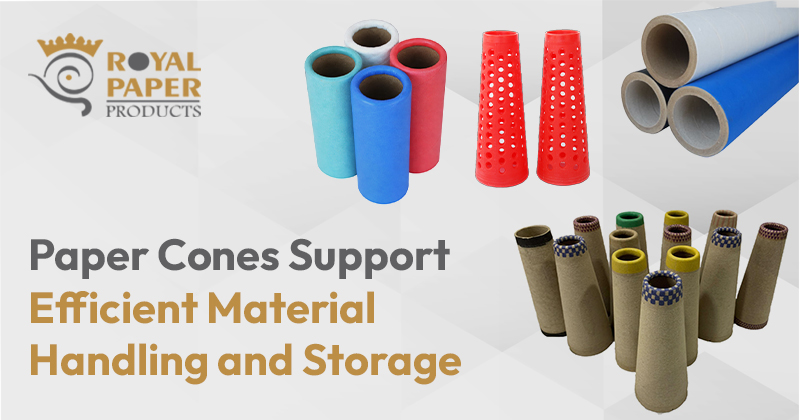
When you walk through a high-speed textile mill or a sophisticated wire manufacturing plant, your eyes are naturally drawn to the massive, humming machinery. But look closer at the heart of the production line, and you’ll see thousands of humble, tapered cylinders holding everything together.
In the world of industrial logistics, Paper Cones Material Handling and Storage is a foundational element that dictates the rhythm of production. They aren’t just “cardboard tubes”; they are precision-engineered tools designed to withstand immense centrifugal force, varying humidity levels, and the rigorous demands of global supply chains.
Let’s dive into why these paper powerhouses are the secret to a streamlined operation.
Precision Engineering for High-Speed Performance
Efficiency in material handling is often measured in rotations per minute (RPM). In modern textile spinning, yarn is wound onto paper cones at staggering speeds.
If a cone is even a fraction of a millimeter out of balance, the resulting vibration can damage expensive spindles or cause “sloughing”—where the material slips off the carrier.
- Custom Tapers: Paper cones are engineered with specific tapers (like 3°30′, 4°20′, or 5°57′) to ensure that the material unwinds smoothly without snagging.
- Surface Texture: From “velvet” finishes to micro-grooves, the exterior of a paper cone is designed to grip the initial layers of yarn or wire, preventing slippage during the start-up phase of winding.
Why this matter for your bottom line?
Smooth winding leads to fewer machine stoppages. In a 24/7 manufacturing environment, reducing “downtime” by even 5% through better material carriers can translate into thousands of dollars in reclaimed productivity.
Optimizing Storage Through “Nestability”
Space is the most expensive commodity in any warehouse. This is where the geometry of the cone shines compared to its cousin, the cylindrical tube.
Because paper cones are tapered, they are nestable. You can stack dozens of empty cones inside one another, drastically reducing their physical footprint.
|
Feature |
Paper Cones |
Cylindrical Tubes |
|
Storage Density |
High |
Low |
|
Shipping Cost |
Lower |
Higher |
|
Handling |
Easy manual separation |
Can be bulky |
By choosing paper cones, facilities can store 3x to 4x more inventory in the same square footage required for straight tubes. This efficiency simplifies Paper Cones Material Handling and Storage by keeping the warehouse organized and reducing the frequency of restock deliveries.
Durability Meets Weight Efficiency
A common misconception is that “paper” implies fragility. Industrial paper cones are manufactured using high-grade kraft paper and specialized adhesives, compressed under immense pressure.
- Compression Strength: They are built to support the weight of heavy filaments without crushing.
- Lightweight Nature: Despite their strength, they are significantly lighter than plastic or metal alternatives.
In the logistics world, weight equals cost. Shifting to high-quality paper carriers reduces the tare weight of every shipment. When you are shipping thousands of units across the ocean, those grams add up to significant savings in fuel and freight charges.
Environmental Management and Diffusion
Modern material handling isn’t just about speed; it’s about sustainability. Customers and regulatory bodies are increasingly demanding “green” supply chains.
Paper cones are the ultimate circular economy product:
- Biodegradable: Unlike plastic bobbins that linger in landfills for centuries, paper cones are 100% recyclable and biodegradable.
- Recycled Content: Most industrial cones are made from post-consumer recycled paper.
- Low Carbon Footprint: The energy required to manufacture paper carriers is a fraction of what is needed for plastic injection molding.
Integrating paper-based solutions into your storage strategy allows your brand to claim a more sustainable footprint without sacrificing industrial performance.
Best Practices: Paper Cones Material Handling and Storage
To get the most out of your carriers, you need a strategy for how they are treated before they ever hit the machine. Paper is a “living” material—it breathes and reacts to its environment.
Climate Control
Paper absorbs moisture. In high-humidity environments, a cone can lose its dimensional stability, leading to fitment issues on the spindle.
Pro Tip: Store your cones in a cool, dry area, ideally on pallets to avoid “wicking” moisture from concrete floors.
- The “First-In, First-Out” (FIFO) Method: While paper cones are durable, long-term storage in fluctuating temperatures can make the paper brittle. Implementing a FIFO system ensures that your inventory stays fresh and performs consistently.
- Proper Palletization: Avoid stacking heavy items on top of boxes containing paper cones. While they have high vertical crush strength, side-impact pressure (common in disorganized warehouses) can “ovalize” the base, making them useless for high-speed winding.
Customization: The Silent Organizer
Efficiency often comes down to visual management. Paper cones can be customized with:
- Color Coding: Assigning different colors to different yarn counts or material types.
- Printed Logos/Barcodes: Facilitating automated sorting and tracking within the warehouse.
- Nose Designs: Bull-nose, burnt-nose, or straight-cut finishes help operators identify the correct orientation instantly, reducing human error.
When your material handling system uses color-coded paper cones, a floor supervisor can spot a “mixed-lot” error from 50 feet away, preventing a costly quality control disaster before it happens.
Cost-Effectiveness: The Bigger Picture
When analyzing the cost of Paper Cones Material Handling and Storage, it’s easy to look only at the unit price. However, the true value lies in the Total Cost of Ownership (TCO).
- Low Initial Investment: Paper is more affordable than plastic or composite materials.
- Zero Maintenance: Unlike plastic bobbins, which must be cleaned and tracked if reused, paper cones are often treated as “one-way” or limited-reuse items, eliminating the labor costs of “reverse logistics.”
- Machine Longevity: Because paper is softer than metal, it causes less wear and tear on your expensive winding machinery over time.
Conclusion,
At Royal Paper Cone, we understand that in the world of high-stakes production, there is no such thing as a “small” detail. We don’t just see paper cones as disposables; we see them as the structural backbone of your operational flow.
When you prioritize Paper Cones Material Handling and Storage, you aren’t just tidying up a warehouse—you are investing in the precision of your winding, the safety of your logistics, and the sustainability of your brand. Our mission is to ensure that from the moment a cone enters your facility to the second it reaches your end customer, it performs with unwavering consistency.
Efficiency is a choice made at every level of the supply chain. By choosing engineered paper carriers designed for the rigors of modern industry, you’re choosing a leaner, greener, and more profitable future. Let’s stop overlooking the “humble” components and start leveraging them for the competitive advantage they provide.